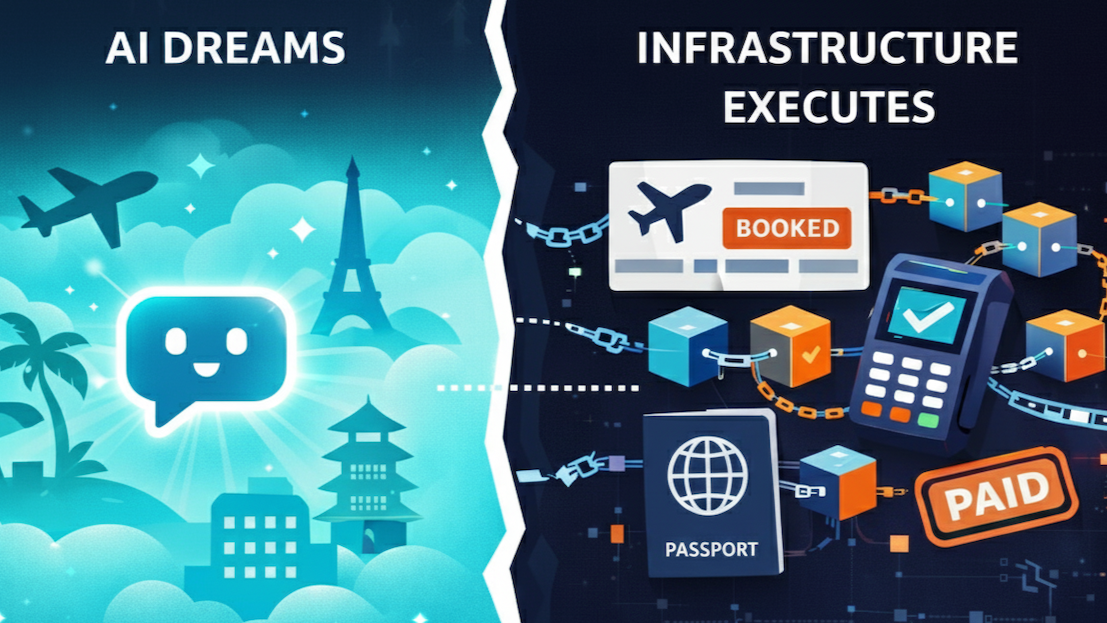
And how the infrastructure we’ve been building for 2.5 years might finally make it possible
It’s December 2025, and AI agents are everywhere. ChatGPT plans your honeymoon to the Maldives. Claude designs a three-week backpacking itinerary through Japan. Perplexity finds you that off-the-beaten-path trattoria in Bologna.
Then comes the moment of truth: “Book it.”
And the magic collapses.
Your agent stutters. It can’t actually check if that boutique ryokan has availability. It hallucinates a confirmation number. It sends you to Booking.com, which means starting the search all over again. Or worse: a Spanish influencer couple recently missed a flight because ChatGPT incorrectly advised them they didn’t need a visa for Puerto Rico, without mentioning the ESTA. The AI was confidently, dangerously wrong.
This isn’t a bug. It’s a fundamental gap in how we’ve built the infrastructure connecting AI agents to the real world.
The gap between imagining and executing
Travel has become the poster child for agentic AI. Every major platform has tried it: Booking.com’s AI Trip Planner, Google’s Canvas travel planning, Kayak’s announced agent capabilities, Expedia’s ChatGPT plugin. McKinsey estimates that 45% of travel-related venture funding in the first half of 2025 went to AI-enabled startups.
Virgin Atlantic just deployed an AI booking assistant built with OpenAI. Their own assessment? The proof-of-concept “wasn’t quite there yet.” Even with direct API access to their flights, they needed to significantly improve the AI’s instruction-following and tool-calling accuracy.
Meanwhile, only 2% of travelers say they’re willing to let AI actually make bookings without human oversight, according to Skift’s State of Travel 2025 report.
Why does the “dream trip” remain just a dream?
The answer isn’t that AI agents aren’t smart enough. It’s that they lack the infrastructure to act responsibly: identity, authorization, payment rails, and accountability. When an agent searches 50 hotels, who pays for that compute on the supplier’s side? When it makes a booking, who owns the reservation? When something goes wrong, who’s liable?
There’s a deeper issue: LLMs are probabilistic systems. They work with patterns and likelihoods, not guarantees—which is why an AI can confidently hallucinate a cancellation policy (as Air Canada discovered in court) or invent a flight that doesn’t exist. Real commerce requires deterministic execution: verified inventory, authorized payments, accountable outcomes. The gap between dreaming and executing is infrastructure, not intelligence.
Big tech builds agentic experiences assuming these problems will sort themselves out. They won’t.
The four problems nobody’s solving
Let me be specific about what’s missing:
Identity. When an AI agent queries a hotel’s booking system, who is it? There’s no “Know Your Agent” standard that verifies whether that agent represents a legitimate consumer, a price-scraping bot, or a sophisticated fraud operation. Platforms authenticate users, but agents act on behalf of users, and that chain of delegation has no standard trust model.
Visa’s Rubail Birwadker recently described the challenge precisely: we need to verify an AI agent’s cryptographic identity and establish a “root of trust” linking a real user to the agent’s credential. As he put it in a recent interview with PYMNTS: “There’s almost a reimagining of the internet going on right now. For the past 30 years, eCommerce has been about keeping bad bots out. Now, the challenge is flipped. The bots showing up represent consumers and real intent to buy.”
Authorization. What is an agent allowed to do on your behalf? Can it spend €5,000 on a flight? Can it access your passport data to autofill a visa application? Today, these limits are enforced by platform policy, not cryptographic guarantees. If an agent exceeds its mandate, you’re left with disputes and chargebacks.
As PYMNTS summarized Visa CEO Ryan McInerney’s December 2025 shareholder letter: “If the interface to commerce becomes a bot, the system still has to know whose money is being spent, what permissions the agent has, and how credentials are presented and authenticated without opening the door to new fraud and cyber risks.”
Payment. How does an agent pay for the services it consumes? Not just the final booking: the searches, the real-time availability checks, the dynamic packaging requests. The travel industry runs on thin margins. Suppliers can’t afford to serve millions of AI-generated queries for free, but there’s no micropayment infrastructure for per-request billing.
Companies like TollBit and Skyfire are starting to address this. TollBit installs website “tollbooths” that authenticate AI traffic and charge for access. Skyfire provides identity tokens and instant payment tokens for verified agents, recently launching “Agent Checkout” powered by an open protocol called KYAPay. But these are general-purpose solutions. They don’t understand travel distribution dynamics, supplier relationships, or the regulatory complexity of cross-border tourism.
Traceability. When a booking dispute arises, how do you reconstruct what happened? Which agent made what request, on whose authority, at what time? Traditional logs are siloed. Off-chain data is mutable. The EU AI Act, now in full effect, mandates strict transparency and traceability for “high-risk” autonomous systems. Without a cryptographically verifiable record of an agent’s decision-making process, companies risk massive non-compliance fines. We need an immutable audit trail—not just for troubleshooting, but for legal survival.
These aren’t theoretical concerns. They’re why Expedia’s partnership with OpenAI requires you to complete bookings on Expedia’s website. Why Kayak’s CEO admits that “one thing Kayak hasn’t done as well as search is booking.” Why a travel expert testing Expedia’s new ChatGPT app found that even the AI itself “warned” users to book direct when possible.
What 2.5 years of building taught us
At Chain4Travel, we’ve spent the last 2.5 years building Camino Network, a Layer 1 blockchain designed specifically for the travel industry. Over 200 travel brands have joined the consortium, including the likes of Lufthansa, TUI, Eurowings, Alpitour, MTS Globe to name a few.
Our original thesis was about B2B distribution: creating a “last integration” promise where suppliers integrate once and connect to any distributor on the network. We built a messaging protocol on Matrix, off-chain to scale encrypted B2B communication to industry-wide search volume, a “cheque” mechanism for per-request micropayments, and NFT-based booking tokens that represent confirmed reservations on-chain.
When generative AI exploded in late 2023, we noticed something: our system, designed for B2B transactions between known distributors and suppliers, mapped surprisingly well to the AI agent problem.
Think about it:
Identity? We have KYC/KYB-verified wallets representing legal entities, with on-chain attestation of verification status.
Authorization? We have CMAccounts (Camino Messenger Accounts), smart contracts that define what services an entity can offer or consume, with configurable permissions and spending limits.
Payment? We have the cheque mechanism: off-chain signed payment commitments (EIP-712) that batch micropayments and settle periodically on-chain. Zero blockchain latency for individual requests.
Traceability? We have end-to-end encrypted message logs with on-chain settlement records. Immutable, auditable, privacy-preserving.
We didn’t set out to solve agentic commerce. We built modular infrastructure for travel transactions, and it turns out those building blocks are agnostic to whether the transacting entity is a B2B distributor or an AI agent acting for a consumer.
From B2B messenger to agentic commerce
This realization led us to develop what we call the “Agentic Messenger,” not a replacement for our B2B infrastructure, but a new capability layer on top of it.
The architecture has three steps:
Step 1: Discovery and steering. A metasearch component that aggregates supplier capabilities, applies touristic context, and enables hyperpersonalization. When an agent asks “find me a romantic getaway in Italy,” this layer provides the intelligence to identify relevant suppliers, match preferences, and route requests appropriately. It’s not just search: it’s contextual steering based on regulation, supplier capabilities, and consumer preferences.
Here’s what changes the calculus: OTAs won because they aggregated demand and provided discovery. In an agentic world, the agent provides discovery. The consumer says “I want to go to Rome in March,” not “I want to search Booking.com for Rome in March.” The shift from user-initiated keyword search to agent-provided intent-based recommendation is qualitatively different from every previous “disintermediation” wave.
Step 2: Direct supplier interaction. When suppliers can serve consumers directly, when they have rack rates, no regulatory barriers, and the operational capability, agents can book directly. Turkish Airlines has already built an MCP server through their Digital Lab, exposing real-time flight status, schedules, availability, and booking capabilities directly to AI assistants like Claude and ChatGPT. Kiwi.com has launched a similar flight search MCP server, noting that “MCP is becoming the go-to interface for AI agents to discover and use services.”
We expose supplier capabilities through standard MCP (Model Context Protocol), with agents connecting via Consumer-type CMAccounts that establish on-chain identity and pre-funded spending limits. Suppliers need no changes; their existing Messenger bots serve both B2B and B2C requests.
Step 3: Tour operator and travel agency intermediation. When regulation requires a licensed tour operator, when suppliers lack public pricing, or when dynamic packaging is needed, agents route requests to TOs and value-adding travel agencies who act as “merchant of record as a service.”
Here’s how it works: the agent sends a “package this for me” request, a hyperpersonalized, LLM-driven specification of a multi-service trip. The TO or travel agency sources components via their existing relationships with contracted suppliers, own inventory or B2B Messenger connections, assembles the package on the fly with their margin, SLA, and service guarantees, and returns a bookable offer.
This isn’t against intermediation. It’s for intermediation when it adds value: regulatory compliance, professional packaging, single point of accountability, consumer protection. We’re against intermediation that extracts margin without adding value to the product.
And crucially, it’s the agent, not the infrastructure, that decides which path to take. That’s the key insight. AI agents are reasoning engines. Let them reason about the optimal flow based on context, regulation, and consumer preference.
Who’s building what, and what’s still missing
The big players are moving fast. 2025 has seen an explosion of competing standards: Anthropic’s MCP for tool calling, Google’s A2A for agent-to-agent coordination, OpenAI/Stripe’s ACP for payments, Coinbase’s x402 for micropayments, Visa’s Trusted Agent Protocol, Mastercard’s Agent Pay. Fragmented protocols across US tech, payment networks, and EU regulation—all emerging within months.
Anthropic created MCP, the Model Context Protocol that’s becoming the de facto standard for how AI agents use tools. In May 2025, Cloudflare announced PayPal, Stripe, and others were building MCP servers enabling Claude to process payments. But MCP defines how to call tools; it doesn’t define who’s calling or whether they’re authorized.
OpenAI launched a ChatGPT App Store in December 2025 with 60+ apps including travel integrations, but apps redirect to external sites for booking. They’ve also partnered with Stripe on the Agentic Commerce Protocol (ACP) for payments. Progress, but it fragments the stack: one protocol for discovery, another for payments, still nothing for identity or cross-supplier accountability.
Visa is furthest along on payment trust. Their Intelligent Commerce program introduces “AI-ready cards” that authenticate a consumer’s agent. In December, they announced hundreds of completed agent-initiated transactions and launched the Trusted Agent Protocol. But Visa solves payment trust, not travel distribution.
Travel-specific MCP adopters like Turkish Airlines, Kiwi.com, Sabre, and Rakuten Travel are building the protocol layer. Good instinct—but MCP alone solves discovery, not identity, payment, or accountability.
General AI-blockchain platforms like Fetch.ai lack travel-specific supplier networks and distribution infrastructure. Their “AI agents booking travel” is a scenario, not a focus.
The industry needs infrastructure that works across all these protocols. Our differentiation is the combination: travel-specific infrastructure, plus identity and accountability, plus micropayment rails, plus 200+ existing supplier relationships. We’re offering the entire stack.
What we’re asking the industry
To travel suppliers: your B2B infrastructure can serve B2C agents with no changes to your existing Messenger bot. The same integration that connects you to tour operators can connect you to AI platforms. Turkish Airlines didn’t wait; neither did Kiwi.com. The question is whether you want to be “MCP-ified” early or wait for the incumbents to define the standard. Industry readiness is mixed. Apaleo’s CEO rates MCP adoption at about 5 out of 10: some 20-30% of hotels are experimenting, while roughly 50% remain constrained by legacy systems. In the agent era, not being machine-readable is the fastest way to become invisible.
To tour operators and travel agencies: the “merchant of record as a service” opportunity is real. AI-generated, hyperpersonalized “package this for me” requests are coming. Your sourcing relationships, SLAs, and regulatory status become more valuable, not less, when agents need professional intermediation for on-the-fly dynamic packaging.
To AI platforms: you’re building agentic commerce without the trust infrastructure you’ll eventually need. “Know Your Agent” isn’t a nice-to-have. It’s what stands between you and the first major fraud or liability incident. We’re offering it as infrastructure, not asking you to build it.
Also, we’re not betting on a single protocol or payment rail winning. Our EUDI wallet work with the APTITUDE consortium means we’re ready for government-attested identity when it arrives. Our participation in the ECB’s Digital Euro Pioneer Programme means we’ve already architected CBDC integration for travel. Stablecoins today, digital euro tomorrow, whatever emerges next—the stack is designed to bridge them. For platforms evaluating infrastructure partners, that optionality matters.
Next steps
We’re finalizing the architecture in January and beginning targeted outreach to AI platform partnership teams shortly after. We’re also tracking Google’s A2A protocol for agent-to-agent coordination—when AI agents need to negotiate with each other, not just call supplier tools. Our architecture is designed to bridge MCP, A2A, and payment protocols through a common trust layer.
If you’re a travel company wrestling with how to expose your services to AI agents, we should talk.
If you’re at Anthropic, OpenAI, or Google and curious how blockchain infrastructure solves the agent accountability gap, we should definitely talk.
The infrastructure for the agentic travel economy doesn’t exist yet. We’ve spent 2.5 years building the pieces. Now we’re opening the doors.
Mik Ruberl is VP Product at Chain4Travel, the company building Camino Network, blockchain infrastructure for the travel industry. He previously served as CTO at Sandos Hotels & Resorts, Head of Architecture & Integration at Alpitour Group, Director Web3 & Blockchain Solutions at Peakwork.
Originally published on LinkedIn.