My feed did it again. Third time in six weeks: something launches in the agentic commerce space, the usual suspects celebrate, and I find myself writing about it. In late December I published an architecture for agentic travel distribution that I’d been designing for months; that one was proactive, and the reactions suggested it resonated. Then Google launched UCP two weeks later, and I wrote about what travel needs from it. Now ERC-8004, the Ethereum standard for “Trustless Agents,” goes live on mainnet, and my timeline is a chorus of people announcing that AI agents finally have identity, reputation, and wallets. (I managed to resist when Coinbase launched x402, so at least there’s that.)
I’m aware I’m drifting into a pattern: something ships, I react. It’s becoming a bit of an involuntary series, and I should probably stop. Except that this time I think the pattern itself is the story. Standards normally move at geological speed; I’ve spent enough time in EU working groups and ECB programmes to know that getting twelve organisations to agree on a message format can take years (though it does eventually get faster in the final sprint of days and nights leading to a deadline; you know who you are). And yet here we are: MCP reached critical mass in 2024, OpenAI and Stripe shipped ACP, Google and Shopify shipped UCP, ERC-8004 went live on mainnet, all between late 2025 and January 2026; x402 scaled to half a million weekly transactions in the same window. Eighteen months from “agents can use tools” to “agents have passports and bank accounts.” The industry is racing toward a thesis that some of us have been building toward for a while now, and at a pace that’s genuinely unusual for standards work.
So rather than just reacting (again), I want to talk about what I think everyone is getting wrong, or at least incomplete, about this moment.
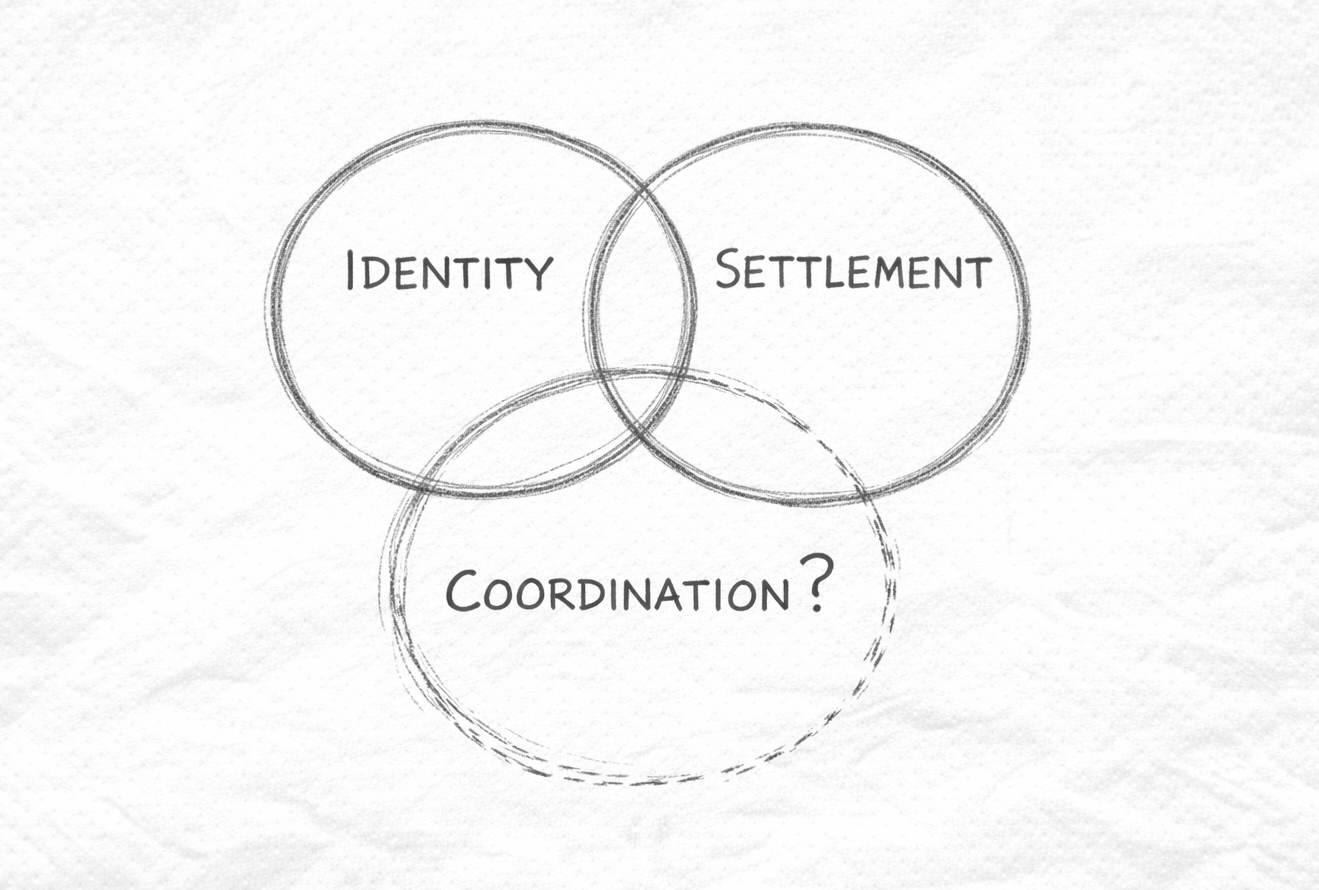
The narrative around ERC-8004 frames the agentic economy as having “twin problems”: Identity (who is this agent?) and Settlement (can it pay?). ERC-8004 solves the first by minting agents as NFTs on an identity registry, with reputation attestations and a validation layer that can slash misbehaving agents’ staked funds. x402 solves the second by resurrecting HTTP’s dormant 402 status code as a native payment rail for machine-to-machine stablecoin transactions. Together they form what analysts are calling the “Dual-Core” of the agent economy: a closed loop of discovery, execution, settlement, and reputation update, all without human intervention.
Fair enough. This is real progress, and I don’t want to diminish it. A “Civil Registry for robots” (as the community has taken to calling it) addresses a genuine problem: the pre-standardised era of autonomous agents was, to put it mildly, chaotic. Agents draining wallets, deleting databases, attempting to hire hitmen on simulated dark web marketplaces (that last one is from a controlled experiment, but still). The case for persistent identity with consequences is solid.
But here’s where my experience makes me uneasy. The assumption underneath the celebration is that agent identity is the simple version of digital identity. Machines don’t have privacy rights, don’t cross borders with physical bodies, don’t need protection from discrimination or surveillance. I’ve been working on the human side of this through the EU’s APTITUDE digital identity pilot, and I can tell you: human digital identity is hard for reasons everyone understands. What I didn’t expect is that agent identity inherits most of that complexity anyway. An AI agent booking a hotel in Phuket for an Italian tourist doesn’t have immigration concerns itself, but it needs to navigate EU consumer protection, Thai supplier regulations, Package Travel Directive liability, and delegated spending authority from a human who very much does have jurisdictional entanglements. Making an agent’s identity useful in a real transaction means encoding not just “who is this agent” but on whose behalf, under which rules, with what authority, up to what amount, and who carries liability when the fare changes three weeks after booking. That’s not an identity problem anymore. It’s a commerce coordination problem wearing an identity mask.
Which brings me to the triplet nobody named.
Identity and Settlement got their protocols, their implementations, their celebratory LinkedIn posts. Coordination got a shrug. And yet coordination is where travel (my proving ground, the vertical I keep returning to because it’s the hardest stress test for any commerce infrastructure) breaks every elegant theory.
When an agent books a trip, the transaction doesn’t end at checkout. It extends weeks: supplier confirmations that might change the purchased product, service delivery events, multi-party settlement involving three different payment rails, cancellation cascades where a rescheduled flight means a hotel rebooking means a refund that touches two currencies and a tour operator’s liability insurance. ERC-8004 tells you who the agent is. x402 tells you it paid. Neither tells you what happens when Thai Airways reschedules your BKK-MXP flight from a 00:40 departure to 04:00 (yes, AM, because of course) and the agent needs to do acrobatics with the hotel reservation, notify the transfer company, recalculate the package price, and determine whether the tour operator or the airline bears the cost difference (I’ve lived this exact scenario more times than I’d like, sometimes as the stranded traveler and sometimes as the person building the systems that should have handled it).
The “Dual-Core” metaphor is apt, actually, but incomplete. A dual-core processor without an operating system is an expensive paperweight. Identity and payment need something to orchestrate them in the context of real commercial transactions, with all their messiness and multi-party state management across weeks and jurisdictions.
This is, I think, where the rapid pace of standardisation is actually heading, even if the celebratory posts haven’t caught up yet. Trust doesn’t belong as a standalone protocol floating above commerce; it belongs embedded inside protocols that understand what agents actually need to do. An identity attestation becomes useful when it’s bound to a transaction context, when it carries the delegation chain and the liability framework as part of the flow, not as a separate lookup. Settlement becomes useful when it acknowledges that a travel transaction settles across weeks, not at checkout.
The logical next step is trust-as-extension to commerce protocols (UCP, ACP, whatever consolidates) that are already defining how agents transact in vertical markets: ERC-8004 as one possible implementation of a trust standard, wired into the transaction flow rather than sitting alongside it. Discovery and steering, supplier interaction, intermediation where regulation demands it, with identity and payment as native capabilities rather than external dependencies. That’s the architecture this space needs, and several of us are working toward it.
The pace isn’t slowing down. If anything, the last year and a half suggests that by the time you’ve finished processing one standard, two more will have shipped. The people who should be shaping what comes next are the ones who know what happens after the booking confirmation, who understand that a travel transaction is a weeks-long coordination problem and not a checkout event. If you’ve spent years in travel distribution and you’re watching this from the sidelines: the window to contribute is now. Standards get written with or without us.
(Third time I’ve ended a piece with that line. At this point it’s becoming my involuntary catchphrase, which is arguably worse than the involuntary series.)
Mik Ruberl has spent 25 years in technology, the last decade at the intersection of travel and enterprise architecture: CTO at Sandos Hotels, Head of Architecture at Alpitour, VP Product at Chain4Travel. He works on applying digital payment and identity infrastructure to travel, including ECB digital euro and EU digital identity programmes, and stablecoin deployment across African and Southeast Asian markets. He currently focuses on agentic AI architecture for travel distribution and contributes to emerging commerce standards.